

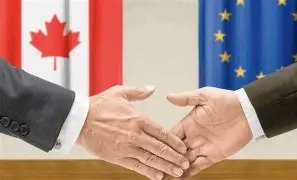
The European Union has proposed making Canada its first-ever “associate member,” signaling a potentially historic transformation in relations between Ottawa and Brussels as both seek stronger economic and security partnerships.
Canada cannot become a full member of the EU under the existing treaty framework because EU membership is open to European states. The proposed associate status would therefore create a new form of partnership rather than give Canada the same rights and responsibilities as the EU’s 27 member countries.
European Commission President Ursula von der Leyen has called for relations with Canada to be raised to the “highest level possible.” Canadian Prime Minister Mark Carney has similarly expressed support for building a unique economic and security alliance with Europe.
Defence and Security Cooperation
Canada has already become the first non-European country to participate in the EU’s €150 billion Security Action for Europe defense programmed. This gives qualifying Canadian defense companies greater access to European procurement projects, joint production opportunities and developing defense supply chains.
The agreement could strengthen Canada’s defense industry while helping Europe expand its military manufacturing capacity and reduce reliance on a limited number of overseas suppliers.
Reducing Economic Dependence
Closer relations with the EU could help Canada diversify its international trade and reduce its longstanding dependence on the United States.
Priority areas are expected to include advanced manufacturing, energy, critical minerals, batteries, artificial intelligence and other strategic technologies. Canada possesses significant natural resources, while Europe offers a large consumer market, investment capacity and advanced industrial expertise.
The existing Canada–EU Comprehensive Economic and Trade Agreement provides an important foundation for this cooperation, although it has still not been fully ratified by every EU member state.
Technology and Digital Innovation
The proposed alliance would build upon the Canada–EU Digital Partnership, through which both sides are already cooperating on artificial intelligence, quantum technologies, high-performance computing, digital regulation and cybersecurity.
Greater coordination could support joint research, responsible technological development and stronger protection against cyberattacks, foreign interference and other emerging threats.
Travel, Study and Business Opportunities
Future negotiations could also consider expanded opportunities for Canadians and Europeans to study, work, travel and conduct business across each other’s territories.
However, suggestions that Canadians may automatically receive EU-wide rights to live, work or retire in Europe remain speculative. Any mobility arrangements would require detailed negotiations and the agreement of EU governments.
Strengthening the Position of Middle Powers
The initiative carries considerable geopolitical importance. Canada and the EU share commitments to democracy, international law, multilateral cooperation and rules-based trade.
A stronger alliance could allow both sides to respond more effectively to economic pressure, supply-chain disruption, security threats and the growing influence of larger global powers.
Important Challenges Remain
The meaning of “associate membership” has not yet been legally or operationally defined. The EU does not currently have a formal membership category of this kind, and it remains uncertain what decision-making rights, regulatory obligations or financial contributions Canada would accept.
Any substantial new agreement could also require approval from all 27 EU member states and, depending on its contents, national ratification procedures.
There may also be political resistance. Critics could argue that closer integration would create additional regulatory obligations, affect Canadian sovereignty or divert attention from expanding trade with Asia and other fast-growing markets.
A New Model of International Partnership
The proposal does not mean that Canada is joining the European Union. Instead, it represents an attempt to create an unprecedented partnership combining trade, defense, technology, energy, critical minerals and potentially greater mobility.
If successfully negotiated, Canada’s associate status could establish a new model for cooperation between the EU and trusted democratic countries beyond Europe—and significantly reshape transatlantic economic and security relations.
Written by: LIIE IMMIGRATION
